create-arsh-tauri: Tauri, one command away
October 21, 2026 · Products
create-arsh-tauri just shipped to npm. The question it answers is concrete: if Tauri brings a Windows installer down from Electron's ~100 MB to single-digit MB, why should adopting it still mean starting from the official template and spending an afternoon on title bars, window permissions and UI?
npm create arsh-tauri@latest my-app
What it is: a Tauri project that's right out of the box
One command gets you a complete Tauri 2 + Vite 8 + React 19 + TypeScript 6 + Tailwind CSS 4 project, plus:
- A frameless window with a hand-rolled title bar: minimize / maximize / close, double-click to toggle maximize, an optional always-on-top pin, drag regions wired up. The title bar and the 8 UI primitives (AppLayout, Button, Dialog, Tooltip, Switch and friends) are the same kit as create-arsh-electron, themed through CSS variables. Two desktop stacks, one feel — pick per project.
- Rust through the front door: a
greetcommand proves the invoke bridge, capabilities ship with least-privilege defaults, and a new command is one registered line away. - Size polish built in: the release profile carries LTO, strip and a single codegen unit; comment them out when you want faster incremental builds.
- A test and CI baseline: vitest is wired up, and GitHub Actions runs lint, typecheck and tests on push/PR, plus
cargo checkon a Windows runner. - An AGENTS.md bootstrap: your first AI session interviews you and rewrites the file into the project's conventions, so the collaboration rules travel with the repo.
Naming is derived too: my-app becomes crate my-app, Rust lib my_app_lib, productName MyApp and appId com.arshdelight.myapp (--scope overrides the prefix), with author pulled from your git config. The placeholders you hunt down in the official template don't exist here.
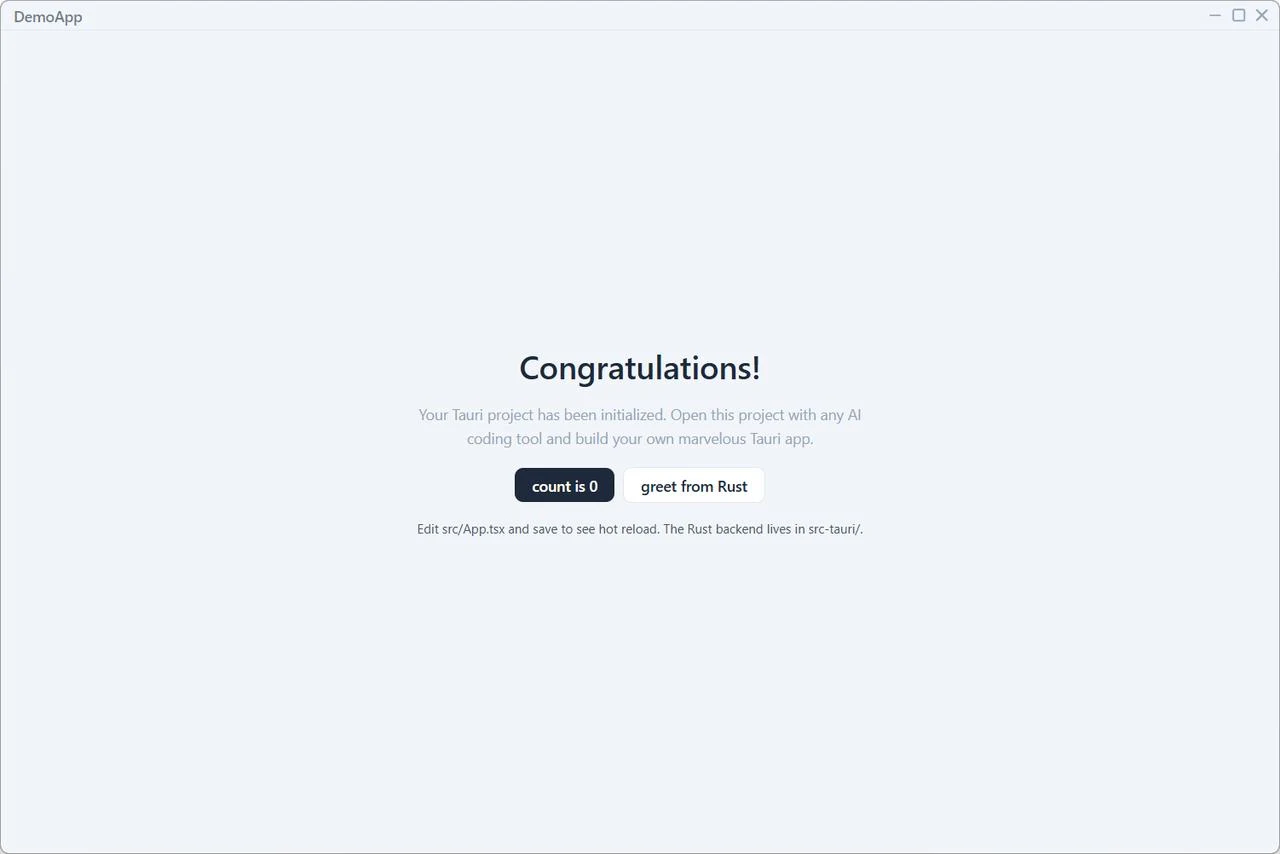
Figure: the starter page on first launch — frameless window with a custom title bar, a counter and a greet demo built in
The numbers
Measured on Windows 11 / Node 24.15 / Rust 1.96: scaffold in 0.6s, npm install in 7.8s, and npm run build producing a 1.2 MB installer in 3m46s (cold Rust compile, bundler tools cached). The same starter app on our Electron scaffold weighs 97.7 MB, roughly 80x more. The first npm run dev waits about 1m40s for the Rust compile; every run after that is instant hot reload.
Thirty seconds to a running app
npm create arsh-tauri@latest my-app(Node ≥ 20.11 plus a Rust toolchain; two prompts: project name, git init or not)cd my-app && npm installnpm run dev. The first run compiles the Rust backend, later runs are incremental, and the window shows hot reload as soon as it opens.
Electron or Tauri? Pick per project
For us the two are not either/or. Projects that rely on Electron's mature ecosystem, or need identical rendering on every user machine, keep Electron; lightweight tools that care about installer size and memory pick Tauri. Both stacks share the same UI kit and the same one-command scaffold, so switching costs nothing. MIT licensed, ready for your next desktop app.
Was this article helpful?
Questions, corrections, or your own take. We read every piece of feedback.